



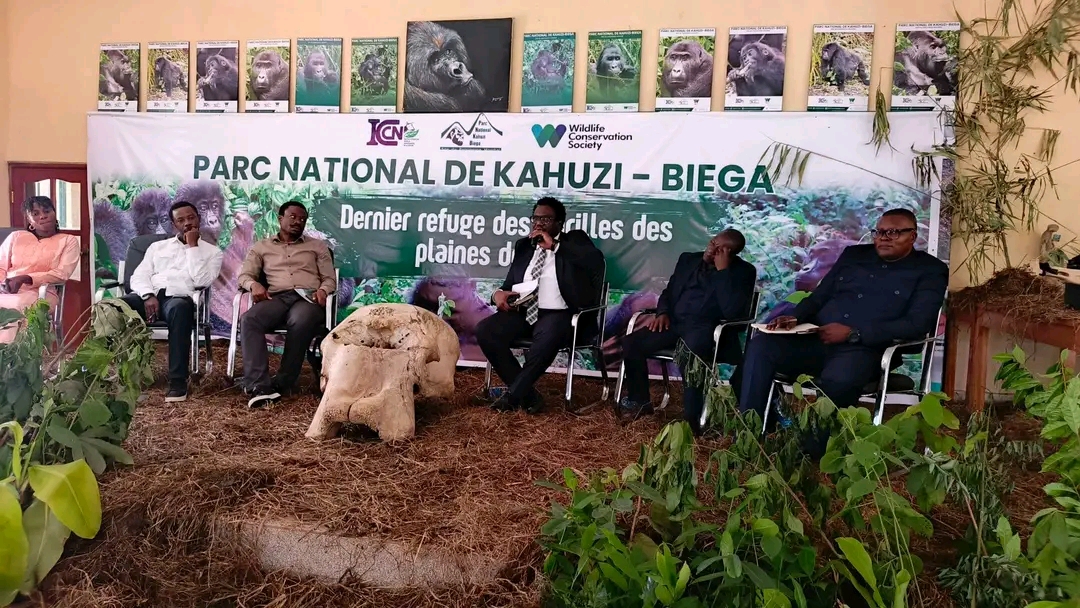
After conservation and monitoring activities were disrupted by insecurity from February 2025, some activities in Kahuzi-Biega National Park (KBNP) have gradually resumed.
Bukavu, By JANVIER BARHAHIGA
In Bukavu, the International Gorilla Day celebration on September 23, 2026, brought together conservationists, researchers and tourism professionals to discuss the threats facing Grauer’s gorillas and the urgent need for better monitoring of the species.
Participants also called on the media to report not only on the challenges facing the park, but also on conservation initiatives and efforts to protect one of the Democratic Republic of Congo’s most important biodiversity areas.
A species under multiple pressures
Grauer’s gorilla, endemic to eastern DRC, has faced intense pressure on its habitat for decades. Agricultural and pastoral expansion, hunting, bushmeat trade, illegal wildlife trafficking and mining are among the major threats affecting the species.
Years of conflict and socioeconomic hardship in eastern DRC have made forest monitoring and wildlife protection more difficult.
At the same time, important gaps remain in scientific knowledge. The behavior, demography, genetics, movements and social organization of Grauer’s gorillas are still less documented than those of mountain gorillas.
How many gorillas are there?
One of the key scientific references for Kahuzi-Biega and the Oku Community Reserve is the study by Plumptre and colleagues, published in 2021.
Based on 230 line transects, the study estimated 1,571 gorillas in Kahuzi-Biega National Park and 2,244 in the Oku Community Reserve. For the entire area covered by the study, the statistical model produced an estimate of 5,252 gorillas, with a 95% confidence interval of 3,687 to 7,481.
The figure of 5,252 should not be interpreted as the global population of Grauer’s gorillas, nor as a 2026 census of Kahuzi-Biega. It is the statistical estimate for the PNKB-Oku study area.
The study also found a substantial decline in gorillas in Kahuzi-Biega since the mid-1990s, while the population studied in Oku appeared relatively stable.
Two years of missing data
Insecurity has made access to some parts of the park difficult and disrupted regular monitoring.
During the International Gorilla Day event, Juvénal Munganga, a delegate involved in tourist visits to Kahuzi-Biega, presented information on several gorilla groups habituated to tourism.
According to the information presented, the Bonane group has nine members, Npungwe 16 and Uhuru seven. Kamirogosa has 10 members and Nabanga eight, with the latter two groups still undergoing habituation.
These figures concern monitored groups and should not be interpreted as a new census of the entire Kahuzi-Biega gorilla population.
“It has been two years without knowing about their lives, whether their numbers have decreased or increased because of the war,” Munganga said.
The uncertainty highlights the importance of restarting field research. The lack of recent data does not, by itself, demonstrate that the population has declined since 2021. It demonstrates the urgent need for new data.
Protecting the forest to protect the gorillas
Participants in Bukavu identified several priorities: protecting gorilla habitat, strengthening anti-poaching efforts, controlling mining activities in critical areas, restoring degraded sites and maintaining ecological corridors between forest blocks.
They also called for regular demographic, genetic and ecological surveys, stronger health monitoring of gorillas and surrounding communities, and livelihood activities compatible with conservation.
Community participation and cooperation among park managers, authorities, researchers and local communities were also identified as essential.
Keeping conservation going during crisis
For participants at International Gorilla Day, the resumption of activities should not be limited to tourism. It should also strengthen habitat monitoring, scientific research and data collection.
They urged journalists to document the threats facing the park, but also local initiatives, conservation achievements and community resilience.
The 5,252-gorilla estimate from the 2021 study therefore remains an important scientific reference for understanding the Kahuzi-Biega-Oku landscape. But five years after that estimate, a fundamental question remains:
What is the current status of Grauer’s gorilla populations in areas that have been difficult to monitor?
New field research will be needed to answer that question and determine what has changed in the forests of Kahuzi-Biega since the last major scientific surveys.