



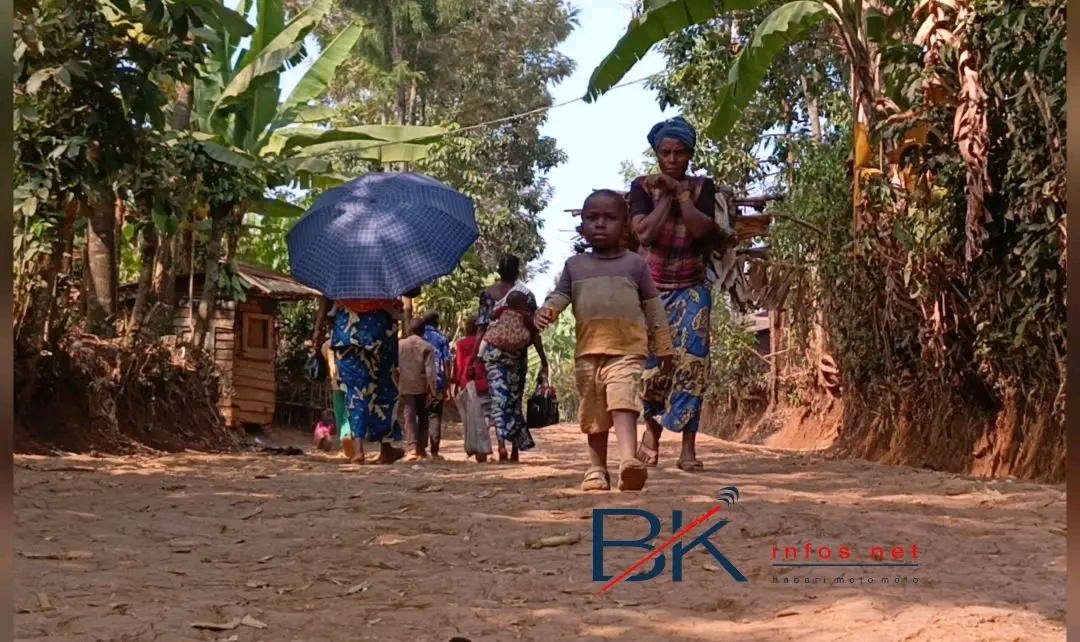
By BKINFOS.CD | A ZUKA Field Investigation
The day Zawadi M’Wa Balegamire fled her village of Kajeje, she had no time to think. She grabbed two sets of clothes, gathered her children and ran. Behind her, she left her home, her pigs, her goats, her fields and the life she had spent years building.
Since then, every morning begins with the same question: When will we be able to go home?
« As soon as the war is over, we will return home immediately. Nobody hates their own home, » she says quietly.
Kajeje, a village located near Kahuzi-Biega National Park (KBNP) in eastern Democratic Republic of the Congo, is among dozens of communities affected by fighting between AFC/M23 fighters and Wazalendo armed groups.For families like Zawadi’s, the conflict has done more than force people to flee. It has disrupted farming, closed schools and shattered local livelihoods.
Today, she does not know what remains of her house.
« We don’t even know who has entered our homes. We only pray that God will bring this war to an end because everything has been destroyed, » she says.
Before the conflict, life revolved around agriculture. Families earned their income by selling cassava leaves, while dock workers depended on daily labor to support their households.That economy has largely collapsed.To feed her children, Zawadi now works as a casual laborer on other people’s farms, earning between 2,000 and 3,000 Congolese francs for a day’s work.
« How can you feed a family with that amount of money, especially if you have many children? » she asks.The burden extends beyond displaced families. Host households many already struggling with poverty now share their limited food supplies with newcomers. »
The families hosting us are suffering too. Sometimes I feel like I am becoming a burden to them, » Zawadi says.
War has also taken a toll on her health.
She says she frequently suffers from malaria, high blood pressure, stomach problems and chronic back pain, while access to healthcare remains limited.Her greatest concern, however, is her children’s future.Since fleeing their village, they have not attended school.
« How can they go to school while the war is still going on? » she asks.
Humanitarian aid has helped her family survive, she says, but survival is not the same as living.What she longs for is peace.Peace that would allow her family to return home.Peace that would let them cultivate their land again.
Peace that would send their children back to school.Because behind every displaced family lies a life put on hold.And behind every abandoned home remains one enduring hope: to return home.
About this investigation
This story is part of a field investigation conducted by ZUKA in partnership with the online news outlet BKINFOS.CD during June 2026.
The investigation interviewed 96 heads of households, including internally displaced people and host families living in communities surrounding Kahuzi-Biega National Park, where fighting between AFC/M23 forces and Wazalendo armed groups has displaced thousands of residents.
Through first-hand testimonies, the investigation documents the human consequences of the conflict, including forced displacement, loss of livelihoods, food insecurity, interrupted education, limited access to healthcare and the growing pressure placed on host communities.