


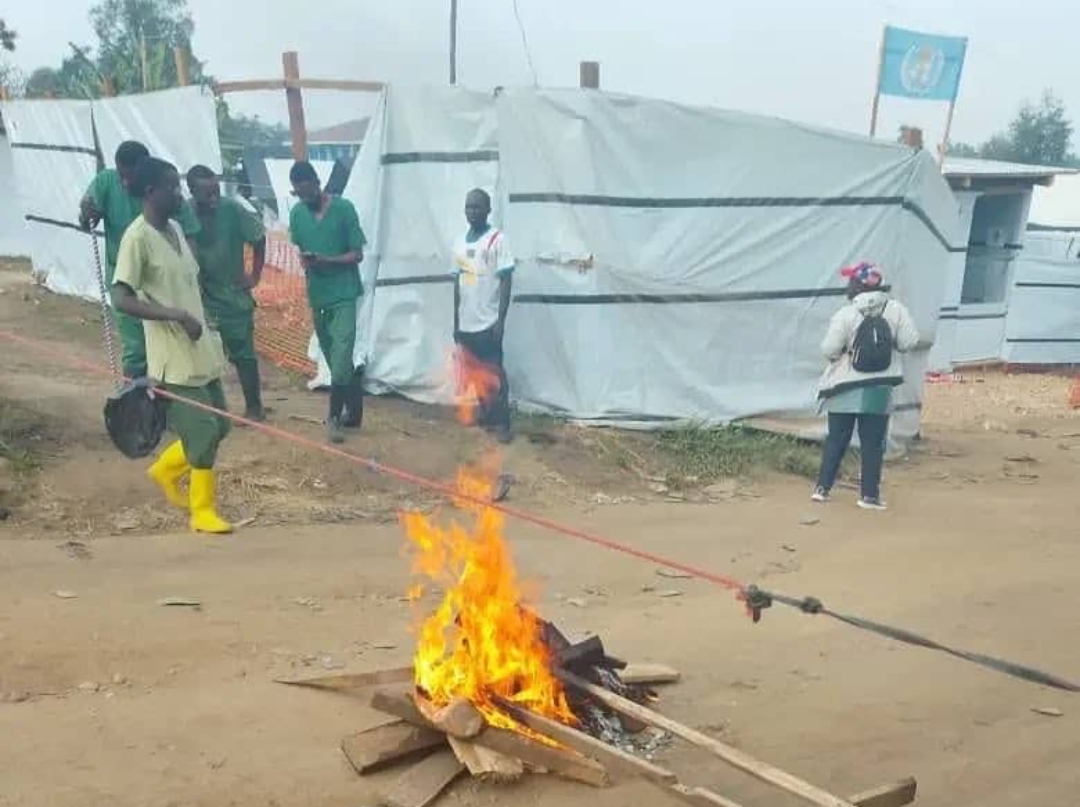
Frontline health workers involved in the response to the Democratic Republic of Congo’s 17th Ebola outbreak have suspended some of their activities over unpaid salaries, raising concerns about the effectiveness of a response backed by millions of dollars in announced funding.
Since 8 July, hygiene workers at the Ebola Treatment Centre (ETC) at CME Hospital in Bunia, Ituri Province, have stopped working, saying they have not received their salaries for more than a month.
Similar protests have also been reported at Rwampara Hospital, near Bunia, where healthcare workers participating in the Ebola response are demanding payment of their allowances.
The industrial action comes despite significant financial commitments announced by the Congolese government and international partners. President Félix Tshisekedi said the government had released US$50 million to support the national Ebola response.
On 2 July, the World Bank announced an additional US$46 million to strengthen response activities across 35 affected health zones. Authorities and partners had previously reported mobilising more than US$25 million for the initial emergency response.
At the regional level, partners have launched an Ebola response plan requiring US$518 million between June and November 2026. In addition, donors announced US$910 million in funding pledges to support Ebola preparedness and response efforts in both DR Congo and Uganda. However, those figures represent funding commitments rather than money already disbursed.
The protests have renewed questions about how quickly response funds are reaching frontline workers responsible for patient care, infection prevention and disease surveillance.
The disruption could affect critical response activities if the payment dispute is not resolved promptly, particularly in Ituri, the province hardest hit by the outbreak.
According to the government’s latest situation report released on 9 July, DR Congo has recorded 1,792 confirmed Ebola cases, including 625 deaths, representing a 34.1% case fatality rate. While Ituri remains the epicentre, cases have also been reported in North Kivu and South Kivu, and two suspected cases detected in Kisangani are still under investigation.
Meanwhile, scientists at the National Institute for Biomedical Research (INRB) continue working on a vaccine candidate targeting the Bundibugyo strain of the Ebola virus. According to Dr Steve Ahuka, the research process is expected to take considerable time before a vaccine becomes available.
At the time of publication, Congolese health authorities had not publicly responded to the workers’ demands or announced when the outstanding salaries and allowances would be paid.